
About the Award
The Sharon A. La Voy Data Impact Award recognizes members of the faculty or staff who have made exceptional contributions to the University of Maryland community through effective utilization of institutional data.
This award honors and recognizes the lasting contributions to the University of Maryland by Sharon A. La Voy (1969-2022), who served as Assistant Vice President for Institutional Research, Planning, and Assessment at University of Maryland from 2015 to 2022. She was a champion for ensuring that institutional data are accessible and transparent to all who needed them for decision making, as well as using data to support and strengthen narratives in service to our students and campus community.
The award is designed to recognize faculty and staff who have utilized or effectively communicated institutional data in a way that has resulted in a positive impact for the UMD community overall or for a specific population/unit within campus. Nominees are not limited to those who manage or utilize institutional data as their primary role.
Conferred at the annual Faculty & Staff Convocation in September.
Eligibility
Potential nominees must meet the following criteria:
- Must be a member of the faculty or staff who has worked at the university for at least three years. Nominations must be for single individuals, not teams.
- Previous recipients are ineligible. However, non-selected nomination packages will automatically carry over for reconsideration for two additional years (annual updates to packets are encouraged).
Nomination
Submit a packet (PDF or MS Word) to mappel@umd.edu containing:
- Nomination cover sheet template
- Nomination letter (1–2 pages) detailing data usage, sources, analysis, and campus impact.
- Letter of endorsement from the unit head.
- One optional letter of support.
- Optional supporting material (max 5 pages).
Selection
Selection of the award recipient is conducted by the Award Committee:
- Appointed by the Provost or designee, chaired by the Assistant Vice President and Chief Data Officer.
- Submits recommendations to the Provost.
- Evaluates nominations using a rubric centered on data integration, unit improvement, and overall campus impact.
Examples of Data Impact
Ways institutional data might be leveraged across the UMD community include (but are not limited to):
- Using qualitative or quantitative data (surveys/focus groups) to propose actionable improvements.
- Improving how data are shared and presented to inform decision-making.
- Assessing business processes, student experiences, pedagogy, or campus climate.
- Creating cross-disciplinary data-sharing initiatives that foster collaboration.
- Infusing data into departmental decision-making to build a "culture of evidence."
- Leading initiatives to improve campus-wide data literacy and ethical data use.
Past Recipients
We are proud to recognize our awardees. Read below to learn about what data mean to them.

Kristi Hall
Associate Director for Undergraduate Education
College of Behavioral and Social Sciences
Data is not inherently meaningful on its own; its value comes from how thoughtfully it is managed and how responsibly it is used as part of responsible governance. In my role, data represents both an institutional asset and a form of trust. Providing accurate, timely information helps colleagues do their work more effectively, while strong data governance and security ensure that this information is used with care and integrity. When data is reliable, protected, and shared in the right contexts, it supports transparency, accountability, and better outcomes for the university community.

Megan Masters
Director, Academic Technology Experience
Division of Information Technology
For me, data is more than just numbers or trends; it is the starting point for a conversation. I see data as a dialogue that connects disparate communities, facilitating meaningful interactions and driving understanding across diverse perspectives. Data should always be transparent, accessible, and equitable, ensuring that it refines our nuanced understanding of the many complexities that shape our world.
It is a privilege to work in, around, and with data. With that privilege comes the responsibility of crafting careful narratives about the implications of those data and the potential impact they can have on the communities they represent. Just as important as analyzing who is included in a dataset is understanding who is not, and ensuring that our work gives voice to all, not just some.
I also believe that an interdisciplinary approach is critical when interpreting and designing evidence-based protocols. We are ALL data people. Data cannot be fully understood or acted upon without drawing insights from a variety of disciplines from the very beginning of an effort, ensuring a holistic interpretation of a given trend.

Kate Siplon
Director, Data Services and Analytics
Division of Student Affairs
Data gives each of us the leverage to more fully know, research, and compare so many facets of our lives - personal and professional. From a plain old web browser, we have access to huge amounts of information that can be put to work in our lives in a myriad of ways. By seeing data about the things that affect us, we see the things that affect us more honestly and transparently. In a professional way, data is a safeguard against bias, inequity and that troublesome "gut feeling" in decision-making. Using data to see the full picture is an incredible part of our culture, now. My kind of data will keep this culture growing!
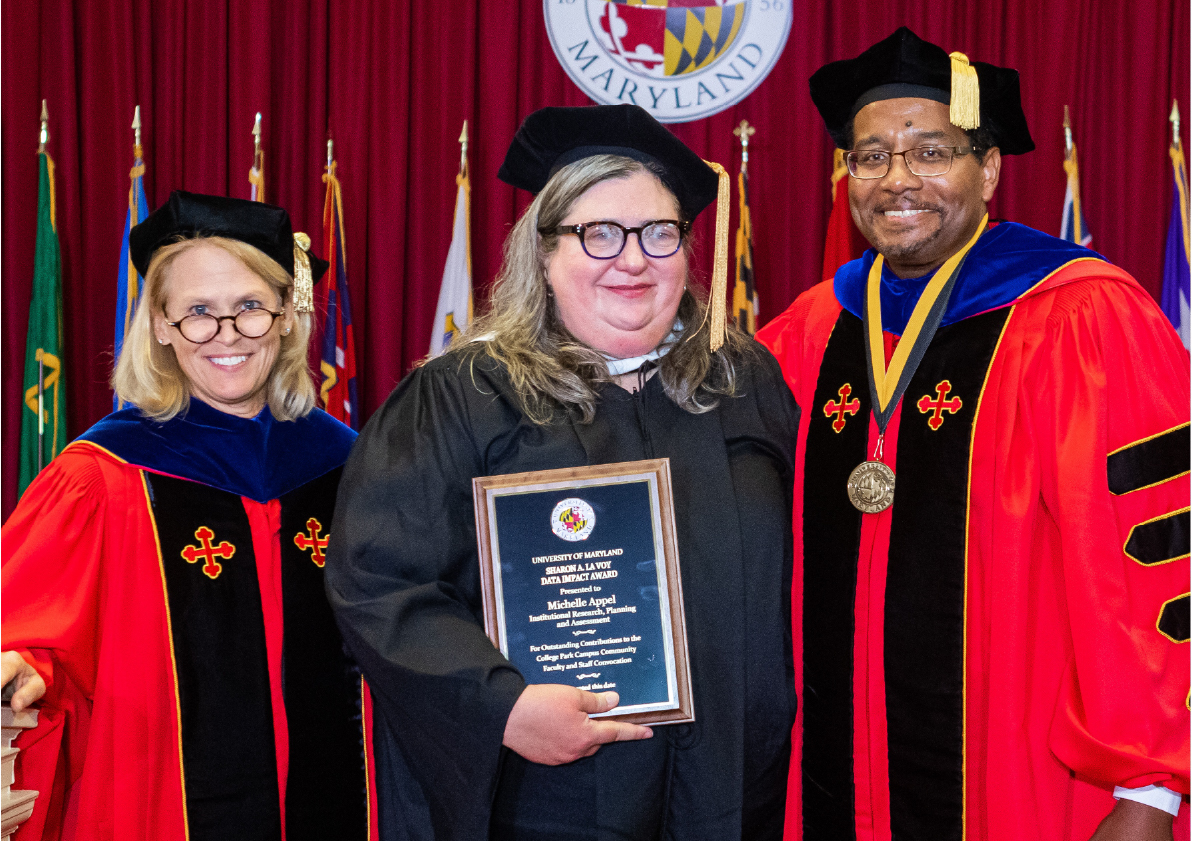
Michelle Appel
Assistant Vice President and Chief Data Officer
Institutional Research, Planning, and Assessment
My kind of data are those that make a difference - in the world, in the University, in my life. I think that data points in and of themselves aren't particularly where the value lies - it is the context, the nuance, the meaning we make of it, and finally the ways in which we use data to take action that are where the real value-add exists.